|
||||||||||||||||||||||||||
|
|
The Jones Sewing Machine Company Sewing Machine Fault Finder Sewing machine Tension Problems
Around 1858 an engineer
named William Jones became fascinated in the new sewing machines that
were coming across from America. At the time William and his brother had
a small engineering plant that made steam engines to power factory
equipment such as pumps, lathes, jigs and other machinery of the period. William must have been a
little like me for he was spellbound with the new fangled contraptions.
He took them apart, found their weaknesses, then rebuilt them. He knew
there was big money to be made in sewing machines and Britain was ready.
He also knew he could undercut the expensive imports of the time. Remember he was in the
centre of England, the heartland of the British industrial revolution.
New ideas and businesses were everywhere, springing up like mushrooms on
a warm August evening. By 1859, William started
to manufacture under licence, the Howe and Wheeler & Wilson
machines. This was not enough for our young lad from the Black Country,
he wanted, not only to make them, but also improve upon them. Oh! And to
make some serious spondoolies as well.
To begin with, the Jones
Long Shuttle Lockstitch was a Howe machine but William had big ideas and
it was not long before he was manufacturing his own models. For some reason, many of
the sewing machine patents he patented were in his brother’s name,
John Thomas Jones. Maybe John was instrumental in their invention? More
likely it was to keep the patents quiet from his big American
counterparts and competitors. William, now on the road
to success, went into partnership with Thomas Chadwick, one of the
pioneers of early British sewing machines. It was most likely for
financial reasons as partnerships often allowed more investment and less
risk. There is only one problem with partnerships—partners! Chadwick was one of the strikers at the Platt Brothers Engineering Works in Oldham. The strike was a turning point in British sewing machine history.
If the Platt strike had not happened at so crucial a moment, it is possible that Bradbury Sewing Machines, our oldest British sewing machine company would never have come to light.
You will have to read
about
Bradbury sewing machines later. For now we are still hot on the heels of William
Jones.
One thing led to another
and after one failed business partnership Chadwick went to Jones and
between them they formed the Chadwick and Jones Company. They operated
from a factory at Ashton-Under-Lyne. Things could not have
gone too smoothly for within three years the partnership was dissolved.
Chadwick, who already had the bitter taste from a former - failed
partnership, whipped off to
Bradbury Sewing Machines, William’s
greatest rival. I bet that was a sore point in the Williams household! Chadwick had known
Bradbury from days of old. In fact they had both been locked out of
Platt Brothers together and had stood on the the picket line arm in arm,
stopping scabs from getting into the factory. Whilst the old
workmates had got back together, it left William free to operate without
restrictions from his former partner. William and his brother were eager beavers and took Chadwick’s departure as a real bonus, it smoothed the way for their expansion and the game was afoot.
By 1869, they had patented their own machines and
managed to get a large contract for Burtons the tailors to supply
heavy-duty industrial machines to some of their factories. The successes
of their domestic and industrial machines lead to their small business
growing beyond all imagination. In all my years in the sewing industry, I have only
come across one Victorian Jones industrial machine and that was
in a ship chandlers that had the machine from new, so they could be
quite rare! Please don’t phone me if you have just found a dozen! William and his brother went on to make some superb
sewing machines, many of which still survive to this day. They copied
popular machines of the day like
Singers New Family machine and the
German transverse shuttle machines and added their own unique models
like the Cat Back. Stamford Works Eventually a great factory grew at Shepley Street,
Guide Bridge, near Audenshaw, on the outskirts of Manchester. At the
Stamford Works factory they
employed thousands of workmen and the machines became a household name in
Britain, much like Hoover or Marmite! Don't tell me you've never heard
of Marmite! It's part of the British constitution. In its heyday the Jones, Stamford Works, factory at Audenshaw employed thousands of skilled workmen. Telephone Ashton-Under-Lyne 2274 The Jones saga was a true story of a small acorn becoming a giant
oak. As the years rolled by William took a back seat and
became the Chairman of the Board overseeing important matters and his
brother John became Managing Director. Along with Bradbury, Jones sewing machines were the
really successful British sewing machines of the Victorian era. There is
hardly a British collection that does not contain a Jones machine, I
have around 20 myself. The Jones Company went on to produce many different
models for over 120 years. If you ordered more than
100 machines you could have your own name put on the machine. This is
something that Singers never did. This is why so many Jones machines
turn up in different dresses.
Queen Alexandra, the connection When The Princess of Wales used one of the Jones machines at one of her technical schools for a year. A testimonial to its reliability came from Marlborough House in London. the Jones Company was quick to act. They marked their machines with Princess Alexandra from then on. On the 9th of
August 1902, with great pomp and circumstance, Prince Edward was crowned
King Edward VII of England. Princess Alexandra, King Edward's wife,
became Alexandra Queen consort. Jones machines were then marked— as supplied to
HRH Queen Alexandra. A testimonial from Princess Alexandra was used to promote the Jones Serpentine machines and later put on the CS model though it was the Serpentine that she actually approved. Princess Alexandra Caroline Marie Charlotte Louise Julia, Alex, was born at the Yellow Palace, an 18th-century town house next to the Amalienborg Palace in Copenhagen, Denmark. At the age of sixteen she was chosen as the future wife of Albert Edward, Prince of Wales and heir to Queen Victoria. She won the hearts of the British people as the Princess of Wales from 1863 to 1901, the longest anyone has ever held that title. Alexandra was Queen of the United Kingdom and the British Dominions and Empress of India from 1901 to 1910 as the consort of King Edward VII.
The
Testimonial March 5th 1890 To the Jones Sewing Machine Company, Sirs, both your treadle and hand sewing machines have been used in HRH, The Princess of Wales' technical schools, Sandringham, for more than a year. They have given every satisfaction both in dressmaking and sewing of undergarments. They are easy to work and in everyway superior to other makes I know. The testimonial from Marlborough house came with consent from Princess Alexandra and with her approval. This was to be a huge boon to Jones for decades. All machines were marked with her Royal Approval and when she became Queen after Victoria's death they machines were marked with Royal Approval Queen Alexandra. The machines that she actually
approved were the early Jones machines of the 1880's known as the
Serpentine model. Out of all the Jones models, probably
the one that is the most synonymous with Jones, is the family model
known as the Serpentine, due to the sweep of the neck matching a
bend in the famous London lake.
Having Royal Approval was a big money spinner as well as a pat on the back. Customers obviously thought if it was fit for the Queen it must be good.
The name Swan Neck was also
used for the Serpentine model but the name that stuck was Cat Back, as
it does have a familiar curve along the top arm to a cat’s back. Their
most popular model ran for 30 years from 1879 to 1909
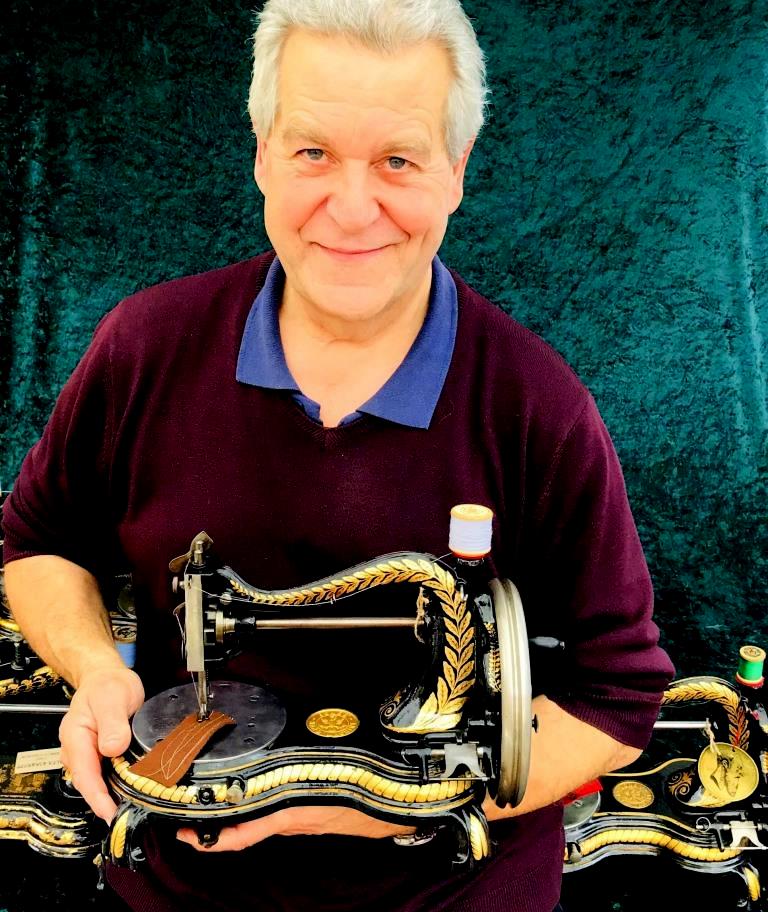
The Jones Serpentine Sewing Machine The Jones Cat Back, Swan Neck or Serpentine. One of the prettiest of all Victorian hand machines and very collectable today. It also came after 1890 with Approved by HRH Princess and later Queen Alexandra. You cannot get a much higher recommendation than that! During WWII the Jones factory carried
on producing sewing machines for the war effort but also produced
uniforms and parachutes. This was unlike the great Singer
factory in Scotland where production of sewing machines ceased for the
duration. Bren guns were made and ammunition in massive quantities, some
20 million bullets per week rolled off the production lines.
The Jones sewing machine company is
one of the oldest sewing machine companies in the world and although the
Jones name disappeared from sewing machines in the late 1980’s Jones
still survives and is now part of the Japanese - Brother industries. A single story factory still stands
today opposite where the huge original 1870 factory once was. Brother industries now own Jones. They were originally famous
for their superb hand built pianos and now make a huge range of domestic and
industrial machinery, everything from computers to keyboards. One final point worth mentioning is
the Jones Sewing Machine Company would mark their machines with many
names such as the Lightning. If a large haberdasheries or iron mongers
came to Jones with a order for over 100 machines they could have any
name they wished upon the machine like Victoria or Harrods. It is one
reason we see so many Jones machines in different skirts - so to speak. I do hope you have enjoyed my brief
history of William Jones and the start of his company. Please do let me know what you think
especially if you have any information of interest to add and do read my
other sewing machine histories, they are pioneering stories of great
men. The end A
brief history of the Jones Sewing Machine Company and William Jones,
©
|
|
||||||||||||||||||||||||